Friday, January 4, 2013

Ocey Snead


Oceana Wardlaw Martin Snead (c. 1885 - November 29, 1909) aka Ocey Snead, was drugged and drowned in East Orange by her own family to collect $32,000 in insurance money and the case made headlines in the NYC area and across the country. The family lived about 5 blocks from Stockton School at 89 North 14th Street (the west side of 14th between Eaton Place and William Street) in October and November 1909. The neighborhood had just been developed with hundreds of houses that were less than ten years old; twenty years before, it had been low-lying farmland. The house is still there on 14th but the house number is different (appears to be 75 N. 14th now) and is part of the Bethlehem Community Church. 


 The Wikipedia article about the case is here
A detailed genealogy of the family is at the Findagrave entry for Virginia Oceana Wardlaw


Below: The "Sisters in Black" (sisters Virginia Oceana Wardlaw, Mary Wardlaw Snead, and Caroline B Wardlaw Martin) as young girls in the 1860 census with their parents and brothers:


 Following are some of the many New York Times articles written about the case:


Below: The Wardlaw sisters with parents and brothers in the 1870 census


Below: From The Pittsburgh Press, May 10, 1910
(the group of drawings and photos at the beginning of this post is also from this Pittsburgh Press article)


More NY Times articles:

Wednesday, January 2, 2013

The Oranges and Newark: Secession and Talk of Reunification

The land that is now Newark and The Oranges was first inhabited by Europeans (by way of Connecticut) about 1675.  By the late 18th century the people living in the western part of the area had tired of traveling the five miles to Newark to do government business and had become wary of the voting power that the more densely populated Newark had over the more rural western area. The area split from Newark in 1806 and the small business area centered on Day Street and Main Street became the government center of the new town of Orange. 

By the mid 19th century the process continued and the farmers and other owners of large tracts of land surrounding the Orange city center decided their interests were not being represented by the people living in "downtown" Orange, so South Orange, West Orange, and East Orange "seceded" from Orange between 1861 and 1863.

Ironically, many of the same  East Orange landowners, who in 1863 had objected to being part of the move in Orange toward developing property for a more dense population and for business and manufacturing, quickly followed the same path and within 40 years had surpassed Orange in population density. Some of this sudden change of attitude was probably the natural inclination to try to outdo the neighboring town by building better government infrastructure like schools, streets, and utilities. But, of course, the main reason was more likely the realization that the land had become much more valuable for houses and buildings than it had been as farms.

As The Oranges became more successful in the late 19th century, discussions started about possible annexations and reunification. There were fears that Newark would use its political power to begin annexing The Oranges one by one starting with East Orange. To preempt  that possibility some people suggested the Oranges reunify to form its own powerful town to avoid annexation with Newark. But most of the people who held political power in each of The Oranges did not want to lose what power they had and decided to take their chances with the status quo and one hundred and twenty years later Essex County (and New Jersey, in general) remains an area of tiny cities and towns. 

Below is an excerpt from a full page article in the New York Times, 1895:


Monday, December 31, 2012

The Woman's Club

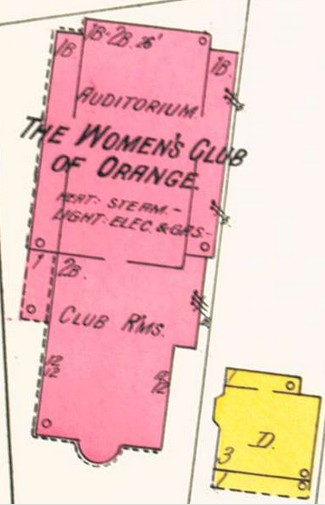
In 1906 a new building for the "Woman's Club" was built on the NW corner of Prospect Street and William Street as seen in the photos below.


Below: the new "Women's Club of Orange" building as drawn on a 1911 Sanborn map; the new building was on the Northwest corner of Prospect Street and William Street diagonally across from the house shown at the top .


Thursday, December 20, 2012

Seabury and Johnson

In 1874, Robert W. Johnson and George J. Seabury, working in East Orange, developed a medicated adhesive plaster with a rubber base. The business was in Doddtown only 500 feet from Franklin School and was listed as on Glenwood Avenue (although the building with the tower appears to front on Franklin Street), between Glenwood Place and Franklin Street. 


Below: 1895 Sanborn insurance map


Below 1911 Sanborn insurance map (note that Sanborn was unable to provide details of the 1911 interior because access to the property was refused)  


Below: from postcard postmarked 1906