Wednesday, August 8, 2012

The Orange YMCA

The Orange YMCA was only a few hundred feet from the East Orange line just a short ride by bicycle, car, or bus from the Stockton School neighborhood.

I attended day camp there for several summers with the mornings spent in swimming lessons at the Y and the afternoons at a camp in South Mountain Reservation where we were grouped by age into various "tribes," Crow and Blackfoot being the only ones I remember, and we hiked, learned archery, and made leather wallets.  

Above: circa 1930

Unfortunately, the swimming lessons were a problem. My father did his best to help me learn when I was young even though opportunities were rare, an early 1950's trip to Lake Mohawk, a visit to a SC lake, occasional visits to the Jersey shore. But it didn't take. I was a terrified sack of skin and bones and sank immediately. My father had grown up in the Ironbound section of Newark a few blocks from the Passaic River and I guess he had learned to swim there in what passed for fresh water in those days. Maybe his older brothers just threw him in at an early age. Or maybe there was a bathhouse in his neighborhood or a YMCA. 

By the mid 1950's he decided to turn the job of swimming lessons over to The Orange YMCA and I took lessons during summer day camp and took additional lessons at other times... sometimes with me taking the bus on summer mornings and sometimes with my father taking me on Saturday mornings. I'd  plead the proverbial stomach ache and sometimes that would get me out of going. The water was highly chlorinated, pretty cold, and I had to stand on tiptoes to keep my nose above water even in the shallow end. We'd push off from the side and I'd go straight to the bottom and wonder if someone would save me.  There were bleachers overlooking the pool and there'd be the occasional spectators at our lessons, parents I hope, now that I look back on it. 

And did I mention that the lessons were in the nude? We were required to strip down in the dressing room, take a shower, and then stand with our backs to the wall next to the pool to begin the lesson.  Over the years I often wondered if that was a national Y policy or unique to our area. About 50 years later a man heard me describing  the lessons and he said the Columbia SC Y had the same policy and he had always wondered if it was unique to that Y.  Any feelings of embarrassment  about the nudity were probably overwhelmed by my fear of the water so I don't think being naked bothered me that much by comparison.  My time at the Y can best be summed up as The Naked and the Dread.

If the Y had had a contraption like the one shown below in this 1930's photo of a bath house in Newark  I might have had a better chance of learning to swim. Maybe.
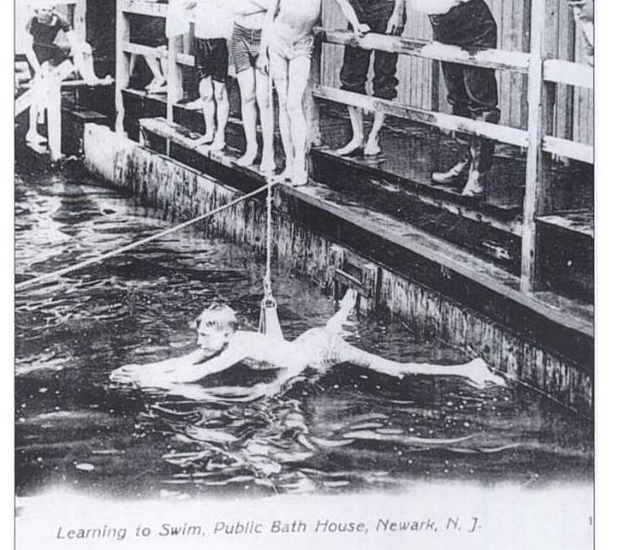
Or maybe the method below for areas without ready access to a pool or lake

By my teen-aged years I had taught myself to swim under water but not on top. After college graduation I enrolled in adult beginner swimming lessons at the YMCA in Alexandria VA and mastered the basics of swimming a couple of laps, treading water for ten minutes and retrieving something from the bottom of the pool,  but I never felt any love for the water other than the occasional body surfing at Virginia Beach or Myrtle Beach. I've always applauded my primordial ancestors for dragging themselves out of the water onto dry land and have never seen much reason to go back.

The Orange YMCA was founded in 1885 as the Central Branch YMCA and its first home was a small house on Main Street next to the North Orange Baptist Church which was on the south side of Main St facing Park St. .

Two years later in 1887 the brick building shown in the drawing and photo below was built next to Grace Episcopal Church diagonally across Main St from the house.

Below: from an 1893 book
Above: from an 1893 book

Below: from an 1899 book


Below: a Sanborn insurance map from 1895


The front portion below was added in 1900.


Above: a Sanborn insurance map from 1912


By 1924 ( but started about 1919) the building had been completely renovated and the Metcalf Natatorium* was constructed.


Below: from American Contractor July 1919


* A natatorium is a building dedicated to a swimming pool


One of the founding members of the YMCA in 1885 was industrialist Samuel Colgate:


Below: In this early 1960's view looking ENE across Day Street down Main Street in Orange, the YMCA can be seen as the long brown building in the distance on the right 

The Orange YMCA on Main Street closed in 1985 and eventually was torn down.


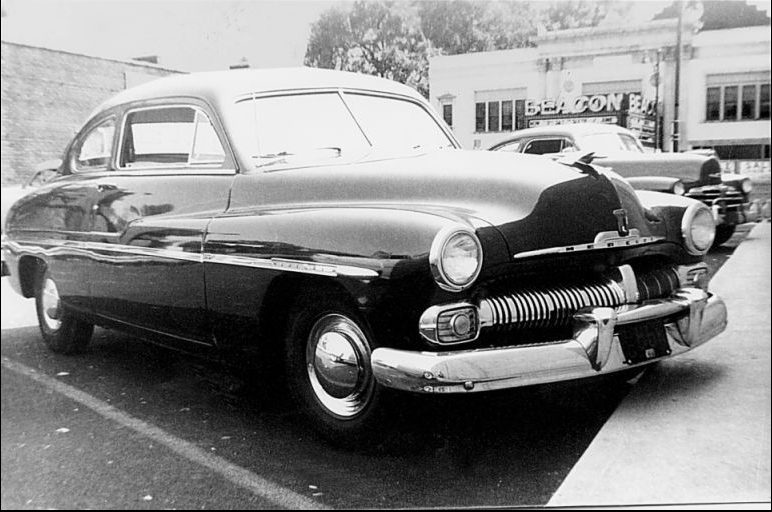
The Beacon Movie Theater

A movie theater operated at the location of The Beacon Theater from about 1923 to 1965.* The theater was built about 1922 as The Strand, but a 1940 movie theater guide lists The Strand as closed, and in the 1941 guide it's listed as reopened under the name The Beacon.  The guide gives the seating capacity as 1200. It was on the SE corner of Main St and S. Grove St in East Orange. 

Above: Photo in October 1964 by Dr Sam Berg, courtesy of the Newark Public Library.

From Film Daily, January 1936: "Acquire East Orange House: Abe Rotner and Sam Kantor have added a fifth house to their circuit. New aquisition is the Strand at East Orange which has been operated by the Ledirk Amusement Company. Kantor and Rotner have four houses in the Rockaways on Long Island."

Below: The Beacon (on the right) in a 1951 photograph); view is looking east on Main Street through the Grove Street intersection


During the 1940's and 50's The Beacon was operated by the Kridel family, a family that also operated The Plaza on North 7th Street in Newark and The Palace in Orange. 

Below: The Beacon as seen from the Kings Supermarket parking lot, circa May, 1959

Below: 1932 map


                       Below: Photo in October 1964 by Dr Sam Berg, courtesy of the Newark Public Library.
My only vivid memory of attending a movie at The Beacon was seeing The Glenn Miller Story there in 1954. I was taken to see the movie one evening by some adult neighbors who knew I was a fan of Miller's music. It was a great experience but the sad ending with the playing of Miller's famous arrangement of Little Brown Jug made me cry and I remember hoping I could get myself together before the lights came up to avoid being too embarrassed. 

My favorite Glenn Miller tune was A String of Pearls and in 1958 I received a birthday present of a 45 rpm record with A String of Pearls on one side and In The Mood on the flip side. I set my automatic record player to play String repeatedly and while the record played I would use my father's bugle from his drum and bugle corps days to pretend to play Bobby Hackett's cornet solo, my favorite part of the song.

Below: from a 1930 Bloomfield newspaper


Below: from a 1945 ad in a Bloomfield newspaper


Above: From Red Bank newspaper, August 6, 1965

From a 1922 builders' guide: 


* The theater building and entire neighborhood were bulldozed in the late 1960's to make room for I-280.

Tuesday, August 7, 2012

Kings Supermarket

The first Stockton area supermarket was this Kings Supermarket built in 1955 on the NE corner of Main St and N. Grove St. across Main St from The Beacon Movie Theater. The site had been the longtime location of First Congregational Church until the church burned down in December 1952.

Above: October 1964

The Kings chain had been started by the Bildner family in Summit in 1936 with Kings and similar chains quickly replacing small square-footage, full-service grocery stores with  large self-service stores which quickly became known as supermarkets. The New Jersey and Long Island suburbs were at the forefront of this revolutionary change. 


Above: inside the prepackaged (a fairly recent innovation) meat department of the new East Orange Kings Supermarket


By 1966 Kings Supermarket was still there but much of the surrounding neighborhood had been bulldozed to make way for I-280. Shortly after, the supermarket met the same fate.


Exterior photos were taken by Dr Sam Berg in October 1964 and are courtesy of the Newark Public Library.

More info about the Bildner family and Kings at Rutgers

The East Orange Lackawanna Station after elevation at Main Street

The Delaware, Lackawanna, and Western Railroad: East Orange Station where the railroad crosses Main St.


                                                                    Above: 1951

                                                                     Below: 1946


Below: 1920's

Below: circa 1952


Thursday, July 26, 2012

The Regent Movie Theater

The Regent Movie Theater operated at 88 Main St (between Greenwood Avenue and N. Hollywood Avenue) from 1915 to 1926. A 1926 Movie theater guide lists the seating capacity as 800.


The Juggernaut showing at the theater in 1915 was a 30 minute movie that had been filmed in South River, New Jersey. A three minute version of the film is available here on Youtube


Above is from The Music Trade Review, 1915. The music business kept up with the movie theater business because the many new theaters had increased the demand for "automatic pianos."

The two articles below were in the same issue of Moving Picture World.


Summer polio epidemics created havoc in the movie theater business.  The summer, 1916 New York City area polio outbreak was particularly bad.

A 1922/23 Film Year Book lists Sol Coleman as the owner of The Regent at 86 Main Street.


Above: The building that housed The Regent Theater can be seen on the far left in this photo (photo courtesy of the Newark Public Library) taken by Dr Sam Berg in October, 1964 as he documented the area before it was destroyed to make way for I-280.

In 1925 The Strand Theater, renamed The Beacon in 1941, opened at 129 Main Street diagonally across the street from where the The Regent had been.


Tuesday, July 24, 2012

South Side of Main St Between Steuben St and Mitchell Place, Oct 1964


Above: The building in this photo had been built in 1924 as The Strand Building and the Strand Theater opened in 1925. In 1941 it became The Beacon.


Above: The Barn restaurant on the SW corner of Steuben St and Main St


Above: Looking SW along Main from the intersection of Main and Grove; Kings Supermarket would be at photographer's back


All of these photos were taken by Dr. Sam Berg in October, 1964 and document this historic neighborhood shortly before it was bulldozed to make way for I-280. The photos are from the Berg Collection and are courtesy of the Newark Public Library. The north side of Main St is here in another post.