Saturday, August 11, 2012

Bob Dylan in East Orange

Robert Zimmerman, later known as Bob Dylan, arrived in New York City from Minnesota in January 1961 with the intent to perform in the NYC folk scene, but also to track down and meet influence and idol Woody Guthrie.


Dylan soon discovered that the best way to meet Guthrie was to travel to East Orange on a Sunday afternoon to the apartment of Bob and Sidsel Gleason at 182 North Arlington Avenue near the southeast corner of Park Avenue and North Arlington Avenue, and  Dylan met Guthrie there for the first time on Sunday January 29, 1961. (date from Woody Guthrie: Writing America's Songs by Ronald D Cohen) The Gleasons had been hosting Guthrie's outpatient visits for several years from Greystone Park Hospital where he was being cared for as he suffered from Huntington's disease.  

Dylan continued to visit the Gleasons and over several weeks in February and March he recorded a group of cover songs there under the title East Orange Tape aka Gleason home tape ( Remember Me  from that tape along with early photos of Dylan). While Dylan hadn't been in NYC very long, he was quickly disappointed with the reception to his performances, began performing at a coffee house in East Orange and in May he hitchhiked back to the Midwest for a month.


He wrote a song called Talkin' New York in which he described New Yorkers' derisive reactions in early 1961 to his performing style and he ended the song with a humorous allusion to his time in East Orange combined with his Midwest trip:

"So one mornin’ when the sun was warm
I rambled out of New York town
Pulled my cap down over my eyes
And headed out for the western skies
So long, New York
Howdy, East Orange"


He also wrote a satirical song, well, monolog, called East Orange, New Jersey (link is to his performance of East Orange at the Gaslight Cafe in NYC, September 6, 1961) about his experience at the coffee house, The Cave* which was on Main Street in East Orange near the SE corner of Main Street and Halsted Street:
First time I ever worked in East Orange, New Jersey --
Folks, never go to East Orange, New Jersey,
It's a horrible town.
I once had to play in a coffeehouse out there.
It was so bad -- uh -- so bad,
People playing chess out there -- uh --
It's all they thought about
Was chess 'n' chess 'n' chess.
People come up to me
You play a song, you play a real quiet song
In the middle of the song ya hear "check"
And "Hey, that was a good move"
And all kinds of stuff like that.Yes, folks, it was so bad I had a little dream out there
The first night I worked,
About this chess playing stuff.
I dreamed I went to work out in East Orange, New Jersey,
And -- uh -- about the time I quit in two days
I went there to ask the guy for my money,
"I worked two days for you"
He says, "Uh, well, o.k., we don't pay money around here, though."
I says, "Uh, yeah?" He says, "Uh, well"
He says, "Uh, we pay chessmen."
I said, "Uh, well, gimme my chessmen then. I worked for two days."
I was sort of -- didn't really figure --
I thought he was lying at first,
But I took it anyway.
He gave me a king and a queen for working two days.
I says, "Uh, fine, that's o.k."
So I took my king and queen, went down to a bar, the nearest bar I could find.
I walked in the bar and ordered a pint.
Down the bar, the bartender,
I says, "Can I have a pint?"
I'll be damned, he give me a pint.
He asks me for the money,
I gave him my king and queen.
I'll be damned, he took that king and queen,
Threw it under the counter,
And brought me out four pawns, two bishops, and a rook for change.
Little story about East Orange, New Jersey.
 Promoter Jerry Schoenkopf, an owner of The Cave in 1961, writes "The real story is Bob came to East Orange every weekend for 4 or 5 months. He got paid in money, not much, but money. There was a lot of chess playing going on. Bob was loved and his music was greatly admired and appreciated. I met Bob at Gerde's Folk City hootenanny on a Monday night and asked him to play at our coffee house in East Orange, The Cave. He did." 


 More about the Sunday visits at the Gleasons   Blowin' in the Wind 1962


*The 1961 East Orange High yearbook references The Cave in a prediction about the 1961 graduates:

"As a late arrival opens the door of East Orange's famous cafe "The Cave," his 
eyes become accustomed to the smog-like atmosphere and he smells the pungent 
espresso coffee perking in time with the beats of the bongos. 
Jimmie Hooper's "Hippers" swing out with a modern version of "On, East 
Orange," while from across the dim room come the opening strains of "Stand 
Up and Cheer," transmitted by Billie Brooks and his combo. 
With an experienced air, Al Monica, the Dick Clark of '81, announces that 
David Tute, the versatile entertainer of international renown, will present his 
ever-popular night club act. 
Suddenly, whistles pierce the smoke as models Judy Curry, Brigitte Falck, and 
Randy Bishop enter, wearing the latest fashions of designer Sharon Jetter. 
Seated in a conservative corner, Sheila Flower, Rosalind Bjornson, and Laura 
Fitzpatrick industriously collect information for their theses on the influence of the 
Cave upon its middle-aged patrons." 


Janis Ian in East Orange

Janis Eddy Fink and her family, parents Victor and Pearl and brother Eric, arrived in East Orange from the New Brunswick area in summer, 1961. They had previously lived on a farm in the NJ town of Farmingdale. During their time in East Orange the family lived at the corner of S. Munn and Central Avenue in a  historic apartment house, The Hamilton,* which was built in 1911 and is considered the first apartment house in East Orange.

                                                                    Above: 1968

Janis attended Nassau School during her first school year in the city, then Vernon L Davey Junior High School for two years, and finally East Orange High School for several months in the fall of 1964, where she spent some of her time writing Society's Child, the song that quickly gave her national recognition. Miss Ian has written that, while she had good teachers at the junior high, she generally found schoolwork unchallenging and took refuge at the East Orange Public Library during her time in the city, and she credits Mrs. Baker, the children's librarian there, for helping her reach her intellectual potential by guiding her to many of the great books the library had to offer.


                                Above: from the 1966 East Orange High School yearbook where Janis is listed as being on the staff of the school's literary magazine (several images from the 1964/65 school year appear in the 1966 yearbook).

Near the end of 1964 the family moved to New York City and by 1965 she was a full-time musician and had changed her name to Janis Ian, Ian being her brother's middle name.

From a 2008 Time Magazine story: 
"How did you get your start in music?
I played for anybody and everybody from the time I started playing guitar, when I was 10 or 11. We were living in East Orange, and I made friends with a bunch of student nurses, and I'd go over to their dormitory and play for them. I gave guitar lessons. I tried to join bands. My mom always said it was obvious that nothing was going to stop me.
How did your song Society's Child come about?
I started Society's Child on a bus in East Orange as I was going home from school. I saw a black and white couple sitting there and started thinking about it. I finished it sitting outside my guidance counselor's office. We moved to New York three or four months later and I started banging on doors."


She achieved even greater recognition when she wrote and performed her now classic At Seventeen, and was announced as the winner of the 1975 Grammy for it immediately after her 1976 Grammy show performance of the song. When it was announced that Janis had won the award,  she received an enthusiastic standing ovation from the audience of her peers. She had also performed the song as the musical guest on the debut show of Saturday Night Live in October 1975.

Miss Ian has lived in Nashville for many years and continues to tour. Her website; her Wikipedia biography

A  former Stockton student has written on a website that Janis Ian's father Victor Fink was a music teacher at Stockton:  "Janis Ian’s father was a music teacher in East Orange @ Stockton School in the 60′s. I still have a ‘recorder’ that I bought in his class for 3$ in 1962. I can still play the recorder solo from ‘Wild Thing’ by the Troggs.  Janis used to play guitar over at my friend’s house on Munn Ave."


Another Stockton student has said that Mr. Fink was her 7th grade homeroom teacher at Stockton during the 1961/62 school year in addition to being a music teacher at the school.

                                        Below: Victor Fink in a 1967 photo


                                                       *Below: The Hamilton

Wednesday, August 8, 2012

The Orange YMCA

The Orange YMCA was only a few hundred feet from the East Orange line just a short ride by bicycle, car, or bus from the Stockton School neighborhood.

I attended day camp there for several summers with the mornings spent in swimming lessons at the Y and the afternoons at a camp in South Mountain Reservation where we were grouped by age into various "tribes," Crow and Blackfoot being the only ones I remember, and we hiked, learned archery, and made leather wallets.  

Above: circa 1930

Unfortunately, the swimming lessons were a problem. My father did his best to help me learn when I was young even though opportunities were rare, an early 1950's trip to Lake Mohawk, a visit to a SC lake, occasional visits to the Jersey shore. But it didn't take. I was a terrified sack of skin and bones and sank immediately. My father had grown up in the Ironbound section of Newark a few blocks from the Passaic River and I guess he had learned to swim there in what passed for fresh water in those days. Maybe his older brothers just threw him in at an early age. Or maybe there was a bathhouse in his neighborhood or a YMCA. 

By the mid 1950's he decided to turn the job of swimming lessons over to The Orange YMCA and I took lessons during summer day camp and took additional lessons at other times... sometimes with me taking the bus on summer mornings and sometimes with my father taking me on Saturday mornings. I'd  plead the proverbial stomach ache and sometimes that would get me out of going. The water was highly chlorinated, pretty cold, and I had to stand on tiptoes to keep my nose above water even in the shallow end. We'd push off from the side and I'd go straight to the bottom and wonder if someone would save me.  There were bleachers overlooking the pool and there'd be the occasional spectators at our lessons, parents I hope, now that I look back on it. 

And did I mention that the lessons were in the nude? We were required to strip down in the dressing room, take a shower, and then stand with our backs to the wall next to the pool to begin the lesson.  Over the years I often wondered if that was a national Y policy or unique to our area. About 50 years later a man heard me describing  the lessons and he said the Columbia SC Y had the same policy and he had always wondered if it was unique to that Y.  Any feelings of embarrassment  about the nudity were probably overwhelmed by my fear of the water so I don't think being naked bothered me that much by comparison.  My time at the Y can best be summed up as The Naked and the Dread.

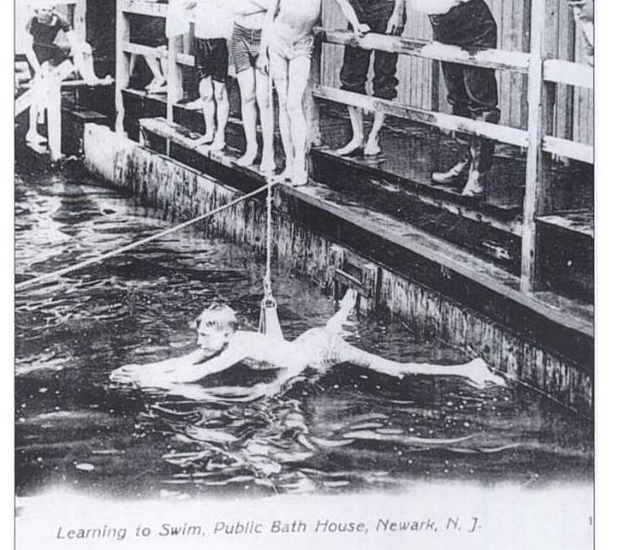
If the Y had had a contraption like the one shown below in this 1930's photo of a bath house in Newark  I might have had a better chance of learning to swim. Maybe.
Or maybe the method below for areas without ready access to a pool or lake

By my teen-aged years I had taught myself to swim under water but not on top. After college graduation I enrolled in adult beginner swimming lessons at the YMCA in Alexandria VA and mastered the basics of swimming a couple of laps, treading water for ten minutes and retrieving something from the bottom of the pool,  but I never felt any love for the water other than the occasional body surfing at Virginia Beach or Myrtle Beach. I've always applauded my primordial ancestors for dragging themselves out of the water onto dry land and have never seen much reason to go back.

The Orange YMCA was founded in 1885 as the Central Branch YMCA and its first home was a small house on Main Street next to the North Orange Baptist Church which was on the south side of Main St facing Park St. .

Two years later in 1887 the brick building shown in the drawing and photo below was built next to Grace Episcopal Church diagonally across Main St from the house.

Below: from an 1893 book
Above: from an 1893 book

Below: from an 1899 book


Below: a Sanborn insurance map from 1895


The front portion below was added in 1900.


Above: a Sanborn insurance map from 1912


By 1924 ( but started about 1919) the building had been completely renovated and the Metcalf Natatorium* was constructed.


Below: from American Contractor July 1919


* A natatorium is a building dedicated to a swimming pool


One of the founding members of the YMCA in 1885 was industrialist Samuel Colgate:


Below: In this early 1960's view looking ENE across Day Street down Main Street in Orange, the YMCA can be seen as the long brown building in the distance on the right 

The Orange YMCA on Main Street closed in 1985 and eventually was torn down.


The Beacon Movie Theater

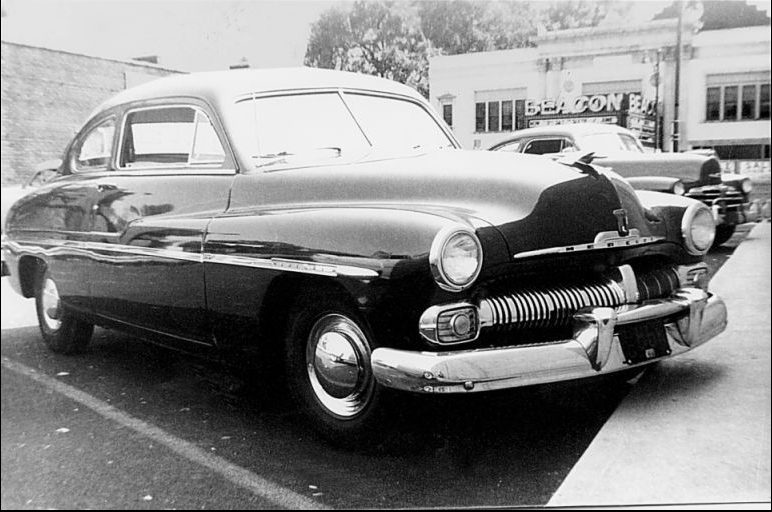
A movie theater operated at the location of The Beacon Theater from about 1923 to 1965.* The theater was built about 1922 as The Strand, but a 1940 movie theater guide lists The Strand as closed, and in the 1941 guide it's listed as reopened under the name The Beacon.  The guide gives the seating capacity as 1200. It was on the SE corner of Main St and S. Grove St in East Orange. 

Above: Photo in October 1964 by Dr Sam Berg, courtesy of the Newark Public Library.

From Film Daily, January 1936: "Acquire East Orange House: Abe Rotner and Sam Kantor have added a fifth house to their circuit. New aquisition is the Strand at East Orange which has been operated by the Ledirk Amusement Company. Kantor and Rotner have four houses in the Rockaways on Long Island."

Below: The Beacon (on the right) in a 1951 photograph); view is looking east on Main Street through the Grove Street intersection


During the 1940's and 50's The Beacon was operated by the Kridel family, a family that also operated The Plaza on North 7th Street in Newark and The Palace in Orange. 

Below: The Beacon as seen from the Kings Supermarket parking lot, circa May, 1959

Below: 1932 map


                       Below: Photo in October 1964 by Dr Sam Berg, courtesy of the Newark Public Library.
My only vivid memory of attending a movie at The Beacon was seeing The Glenn Miller Story there in 1954. I was taken to see the movie one evening by some adult neighbors who knew I was a fan of Miller's music. It was a great experience but the sad ending with the playing of Miller's famous arrangement of Little Brown Jug made me cry and I remember hoping I could get myself together before the lights came up to avoid being too embarrassed. 

My favorite Glenn Miller tune was A String of Pearls and in 1958 I received a birthday present of a 45 rpm record with A String of Pearls on one side and In The Mood on the flip side. I set my automatic record player to play String repeatedly and while the record played I would use my father's bugle from his drum and bugle corps days to pretend to play Bobby Hackett's cornet solo, my favorite part of the song.

Below: from a 1930 Bloomfield newspaper


Below: from a 1945 ad in a Bloomfield newspaper


Above: From Red Bank newspaper, August 6, 1965

From a 1922 builders' guide: 


* The theater building and entire neighborhood were bulldozed in the late 1960's to make room for I-280.

Tuesday, August 7, 2012

Kings Supermarket

The first Stockton area supermarket was this Kings Supermarket built in 1955 on the NE corner of Main St and N. Grove St. across Main St from The Beacon Movie Theater. The site had been the longtime location of First Congregational Church until the church burned down in December 1952.

Above: October 1964

The Kings chain had been started by the Bildner family in Summit in 1936 with Kings and similar chains quickly replacing small square-footage, full-service grocery stores with  large self-service stores which quickly became known as supermarkets. The New Jersey and Long Island suburbs were at the forefront of this revolutionary change. 


Above: inside the prepackaged (a fairly recent innovation) meat department of the new East Orange Kings Supermarket


By 1966 Kings Supermarket was still there but much of the surrounding neighborhood had been bulldozed to make way for I-280. Shortly after, the supermarket met the same fate.


Exterior photos were taken by Dr Sam Berg in October 1964 and are courtesy of the Newark Public Library.

More info about the Bildner family and Kings at Rutgers

The East Orange Lackawanna Station after elevation at Main Street

The Delaware, Lackawanna, and Western Railroad: East Orange Station where the railroad crosses Main St.


                                                                    Above: 1951

                                                                     Below: 1946


Below: 1920's

Below: circa 1952