Saturday, August 13, 2011

The Battery "A" Armory

Built in 1912, the Armory was on North Oraton Parkway between Park Avenue and William Street. The building is still there but was sold by the NJ Military Dept. in 1997 and now serves as "The Islamic Center."


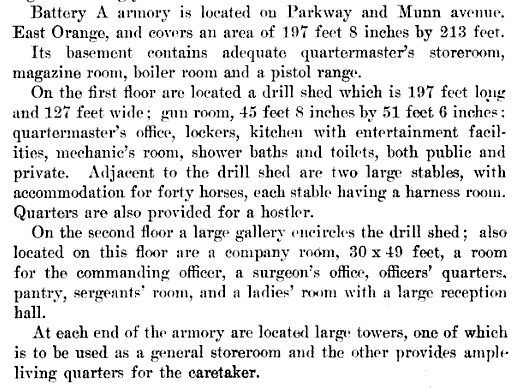
A former Stockton student writes that she remembers going to the Armory to see her uncle, who was in the army reserve,  play indoor polo there. Below is an early 20th century description of the building's interior:

Below: The stone monument was in the grass median on Oraton Parkway in front of the Armory. When the Garden State Parkway was built about 1954, the monument was moved to within a few feet of the front of the Armory. The stone is still there in front of The Islamic Center but the plaque has been removed.
 Postcard view of Battery "A" (circa 1915/1920) and family photo (circa 1951) above are both courtesy of former Stockton student Pat Quinn who lived a few houses from the Armory on its William St side.  
                              

Inez Louise Wilcox: Stockton Teacher 1905-1906

In the following 1955 letter, Mrs. Inez Louise Wilcox Dennison briefly describes her education and career which included being a teacher at Stockton, "the beautiful new school," during its first year, 1905/06. Mrs. Dennison was born in 1881 and died in 1961. Her letter mentions that she started her time in East Orange at "Eastern Grammar School" in 1901.


Above: 1905 postcard photo. Willimantic Normal* School was established in 1889 and eventually had its own campus around 1895.

*A "normal school" was a school created to train high school graduates to be teachers. Its purpose was to establish teaching standards or norms, hence its name. Most such schools are now called teachers' colleges; however, in some places, the term normal school is still used. (from Wikipedia)


Wednesday, August 10, 2011

Parks, Parkways, and The Garden State Parkway

The first parkways in the US were developed in the late 19th Century by landscape architects Frederick Law Olmsted and Beatrix Farrand as roads segregated for pedestrians, bicyclists, equestrians, and horse carriages. The terminology "parkway" to define this type of road was coined by Calvert Vaux and Frederick Law Olmsted in their proposal to link city and suburban parks with "pleasure roads."


Above: "Black Brook Valley" on 1878 Map.

 "Black Brook Valley" was the bog land between Grove St and Arlington Avenue; drain lines were installed in the "Valley" in 1899 and the first section of the East Orange Parkway (later known as the Essex County Parkway and then Oraton Parkway) from William St to Main St was built in 1900; the William St to Park Avenue section was built soon after. By the 1930's Oraton Parkway ran from Springdale Avenue at the north end (less than a mile from Watessing Park) to Springfield Avenue at the south end, a distance of three miles. It passed by Holy Sepulchre Cemetary, Vailsburg Park, and, on the south end, came within two blocks of Irvington Park.

Below: 1911 Map

Below: probably looking south from near Park Avenue
Below is a small section of a plan for the entire Essex County Park system commissioned 1898 to 1900 by a county committee and completed by the Olmstead Brothers, sons of the designer of Central Park. The plan covered the design of Branch Brook Park, Eagle Rock Reservation, South Mountain Reservation and all other parks in the county. Connecting all the parks with parkways was part of the plan. To paraphrase one quote from the era:  "We have the pearls, we just need to string them together." The Parkway in East Orange was one small part of the plan: 


                                     Above: probably looking north from near New Street

                                                  Below: looking north from Main Street


Above and below: looking north from Lackawanna Railroad bridge


Above: circa 1905 view north toward New St from Lackawanna overpass
(There is a circa 1901 photo looking up from the parkway south toward the  same overpass on p.69 of  East Orange Images of America by Bill Hart, Arcadia Publishing)


Above: looking north at Lackawanna overpass from Main Street side 

Below: looking south at the Lackawanna overpass from the New Street side toward Main Street


Above: looking south from Main Street circa 1911

Below: looking south from Main Street toward Central Avenue, circa 1915-1920; many of the houses shown here had been built after 1911 


Above and below: looking NE from near railroad; Davis Place is to the right


Above: circa 1911 view north toward New St from Lackawanna overpass


Above: postcard view is from under the Lackawanna overpass looking north toward New St (a through street then). The statue of Lincoln at New St and Oraton appears in the distance.


Below: President Taft laying a wreath at the statue in 1912 about eight months after the statue's dedication on June 14, 1911


The statue was moved to the City Hall area in the mid-1950's when the Garden State Parkway was built

Below: the southern end of the parkway near the Newark/Irvington line

Below: from a 1909 story in the New York Times

Above: from a 1922 planning report


Below: postcard view (circa 1935) is from on or near William St looking north toward Park Avenue with rock monument in front of Armory in the distance. 

                                          North Oraton Parkway postcard photos courtesy of Pat Quinn


By the 1930's and 40's, the 19th century concept of parkways was considered to have been made obsolete by the modern automobile. A 1945 report admitted as much and foresaw the coming Garden State Parkway:


Above: Garden State Parkway, looking south from the William St overpass toward the
Lackawanna overpass 1959

The construction of The Garden State Parkway started the destruction of a historic African-American neighborhood sometimes called the "Jones Street" neighborhood. The building of I-280 completed the loss of that neighborhood and many other neighborhoods.

Sunday, August 7, 2011

Stockton Principals: 1905 to 1960

William Hemans Smith: 1905-1908
Charles Jacob Vrooman: 1908-1922
Edward Huntington Dutcher: 1922-1929
Paul Sloat Miller: 1929-1940
John Thomas Greenan: 1940-1952
William George Hayward: 1953-1955
Paul Alfred Shelly: 1955-1960

From 1922 to 1955 Stockton principals were simultaneously also principals of Eastern School, a school that was gradually phased out starting in the 1940's and finally torn down in the 1960's with the construction of I-280.

Saturday, August 6, 2011

Edward Huntington Dutcher: Principal 1922 to 1929

Edward H Dutcher (A.B. University of Vermont, 1882) came to the East Orange school system in 1891 to be principal of Eastern School, replacing Vernon L Davey who had become East Orange school superintendent. In the early 1920's, probably at the death of Principal Vrooman in 1922, Mr Dutcher was appointed principal of Stockton, serving as principal of both schools till his death in 1929. At his death he had been principal of Eastern School for 38 years and Mr Dutcher was followed as principal of both schools by Dr. Paul S Miller.

Mr. Dutcher was born August 25,1860 and died March 3, 1929. His obituary (NY Times 3/4/1929) lists spouse Edna Cobb Dutcher* and son Hamilton Dutcher (Edward Hamilton Dutcher from a first marriage to Helen Eugenia Hamilton). A 1900 Phi Beta Kappa catalog lists him as having an A.M. degree. From 1883 to 1885 he led the last years of Barre Academy in Vermont (which was then transferred to the public school system in 1887) and from 1885 to 1891 he's listed as  principal of "Brandon Graded School," another school in Vermont.

*There is a Miss (Mrs?) Dutcher on a 1930's Stockton teachers' list and, since Dutcher isn't a common name,  it's likely that Principal Dutcher's widow Edna Cobb Dutcher is the Stockton teacher. Also, former Stockton student Pat Quinn found a 1930 census listing that shows Edna Cobb Dutcher's occupation as "teacher."

Thursday, August 4, 2011

William George Hayward: Principal 1953 to 1955

Above: from the 1967 East Orange High School yearbook when Dr. Hayward was Assistant Superintendent of East Orange Schools

Dr. W.  George Hayward (Ed.D, 1940) was principal of Stockton (and Eastern School) from 1953 to 1955. He followed John Thomas Greenan and preceded Paul Alfred Shelly. In 1931 Dr. Hayward is listed in a Columbia University catalog with a B.S. from Rutgers in 1930 and as a student in the masters program of Columbia. In 1934/35 and 1937/38 he's listed as a student at Columbia with an A.M. degree, possibly working on his doctorate.

In the 1940 census he's listed as living at 21 Whittier Street in East Orange with wife Mabel and daughters Doreene and Geogeanne.

In 1936 (although one education article in 1937 shows him with Hohokus Township Public Schools in Mahwah) he was appointed principal of Elmwood School in East Orange and in 1947 he is listed in a Lehigh University (Bethelehem, PA) catalog as both principal of Elmwood and an instructor at Lehigh. By the late 1950's he was Assistant Superintendent of Schools in East Orange, retired from the school system in 1967, and in 1969 he was a professor of education in the masters program at Monmouth College with a Red Bank newspaper article emphasizing that his credentials lent weight to that college's masters program.


Photos below are from the July 16, 1948 issue of the Lehigh University newspaper, The Brown and White.


Above: photo and article from the newspaper of the 
State Normal School at Oswego, NY, July 1936