Saturday, November 8, 2014

The Palace Movie Theater


From  the July 22, 1916 issue of Moving Picture World


                                              Below: St Petersberg Times, Oct 4, 1930

Below: In 1937 The Palace Theater was remodeled in Art Deco style.


 The Palace auditorium was bisected by the city line between Orange and East Orange, and prior to repeal of some of the old Sunday Blue Laws, the left side of the auditorium had to be roped off on Sundays, as East Orange forbade the showing of movies on Sunday and all seating had to be within the Orange city limits!

Oct 2, 1930, The Olean Times Herald, Olean, NY

KEEP SUNDAY LAW WITH ROPE LENGTH (By United Press) Orange, N. J., Oct. 2.--The Palace moving-picture theater, which stands on the dividing line between this town and East Orange, with half of Its seats in one town and the other half In the other, will on future Sundays preserve the piety of East Orange with a length of rope. Orange Is legalizing Sunday moving pictures. But East Orange stands firmly against them, and Mayor Charles H. Martens of East Orange has announced he will rope off his half of the theater "to protect East Orange from the affects of Sunday movies in Orange."


Monday, November 3, 2014

The Halsted Movie Theater

          The Halsted Theater was on the north side of Central Avenue near the Halsted Street intersection.


Above: the photo and article are from an October 10, 1914 issue of the magazine  Reel Life

                                                           Below: circa 1920 letter


No mention of The Halsted (sometimes misspelled as Halstead) appears after the 1920 envelope above. It's possible that the name of the theater was changed, possibly to The Oxford, or that it simply closed after the opening in 1925 of the much larger Hollywood Theater on Central Avenue several blocks away

Sunday, November 2, 2014

The Hollywood Movie Theater

The Hollywood Theater operated on Central Avenue near the South Harrison Street intersection from 1925 until the 1970's or 1980's. 


The theater had 1500 seats and, on May 16, 1940, hosted the world premier of the movie Edison the Man starring Spencer Tracy. (Tracy stayed around the corner on South Harrison at The Hotel Suburban while in town)


A New York Times article about the short-lived reopening of the Hollywood Theater in December, 2006


Saturday, November 1, 2014

Movie Theaters in East Orange

1) The Beacon/Strand,129 Main St, 1925-1965, 1200 seats

2) Hollywood, 634 Central Ave, 1925-late 1970's, 1500 seats (revived as a multiplex 12/2005, closed again 2007)

3) Ampere, 237 N. 18th St,  circa 1918-1970's (?), 430 seats

4) Ormont/Lyceum, 508 Main St (the Masonic Temple), circa 1915-1970's?, 900 seats

5) Palace (called the U.S. Palace in its early years), 4 Main St. in Orange (with a portion in East Orange), 1915-circa 1980's, 1200 seats

6) Regent, 88 Main St, 1915-1926, 800 seats

7) Oxford Theater, 500 seats; In 1926 the Oxford Movie Theater was taken over by an organization called the International Film Arts Guild to present foreign films and experimental films. In 1928 it's listed as a theater for Avant-Garde/experimental films and in 1932 it's listed as closed. It's possible that The Oxford was simply an existing theater renamed e.g. It may have been The Halsted Theater building;**

8) Brighton/Dodd/Park, Dodd Street near North Park St, mentioned in a 1918 and 1928 articles, 600 seats; A 1922 city directory has The Brighton at 387 Dodd St and a 1930 city directory has it at 409 Dodd Street. *

9) Halsted Theater, 524 Central Avenue, mentioned in the Oct 10, 1914 issue of Reel Life and last mentioned in the May 18, 1918 Moving Picture World magazine.**

Below: from the 1928 "Yearbook of Motion Pictures." (The East Orange movie theaters were listed under Orange along with the Orange movie theaters)


A 1922 City plan for East Orange reported that the city had "six motion-picture theatres," but the 1922/23 film yearbook listed only 3 theaters in East Orange: The Palace, The Regent, and The U.S., but The Palace and U.S.are probably the same theater, so the list is confusing. The city plan may have also included The Ampere, The Halsted, and The Brighton even if they were closed at the time.

Below: from a 1945 "Film Daily Yearbook"


An April 26, 1913 issue of the New York Clipper reported that two permits were issued for theaters in East Orange: one for a 500 seat theater valued at $18,000 and one for an 850 seat theater valued at $80,000 owned by E.H. Fredericks and A.W. Edelmeyer.


Below: Oct 2, 1930, The Olean Times Herald, Olean, NY
KEEP SUNDAY LAW WITH ROPE LENGTH (By United Press) Orange, N. J., Oct. 2.--The Palace moving-picture theater, which stands on the dividing line between this town and East Orange, with half of Its seats in one town and the other half In the other, will on future Sundays preserve the piety of East Orange with a length of rope. Orange Is legalizing Sunday moving pictures. But East Orange stands firmly against them, and Mayor Charles H. Martens of East Orange has announced he will rope off his half of the theater "to protect East Orange from the affects of Sunday movies in Orange."

                                Below: From 1918 news articles in Moving Picture World


                                                                **The Oxford:

                                              Below: from various sources in 1926/27


The 1931 Film Daily Year Book lists The Oxford but the 1932 edition lists it as "closed."

*The Brighton:

The 1930 and 1931 Film Daily Year Books list The Brighton, but the 1932 edition lists it as closed. The 1933 edition no longer lists The Brighton, but, instead lists The Dodd with the same seating capacity (483). The 1934 edition then lists The Dodd as closed, but the 1935 and 1938 editions list a theater named The Park with a similar seating capacity (550). The last mention of The Park is a listing as "closed" in a 1949 theater directory.

Wednesday, October 22, 2014

Llewellyn Park


1853 --  Llewellyn Haskell  buys the old farmhouse belonging to Henry Walker.
1854  --  Haskell begins building his house, the Eyrie (meaning the nest of a bird of prey), on the foundation of Henry Walker's old farmhouse.  The house was designed by famous architect Alexander Jackson Davis.  Haskell founded nearby Llewellyn Park, America's first planned community. He had wanted Eagle Rock to be part of Llewellyn Park, but that did not come to pass.
1860  --  the New York Illustrated News published a wood engraving of Eagle Rock, the earliest depiction of the rock.
1860  --  the gate house at the main entrance to Llewellyn Park designed to look like the Eyrie.
1872  -- death of Llewellyn Haskell.

Llewellyn Park history


Glenmont is located in Llewellyn Park, West Orange, the first romantically designed, planned residential community in the United States. The community was developed in the 1850's by Llewellyn Haskell, who had acquired 350 acres in West Orange, New Jersey, about fifteen miles from New York City. The architect Alexander Jackson Davis landscaped the park, which grew to 700 acres by the 1870's.
A Queen Anne style mansion with 29 rooms, Glenmont was designed by the architect Henry Hudson Holly. Edison purchased the Glenmont estate – 13.5 acres including house, barn, greenhouse, and furnishings – in January of 1886 for $125,000, half its estimated value.


Tuesday, October 7, 2014

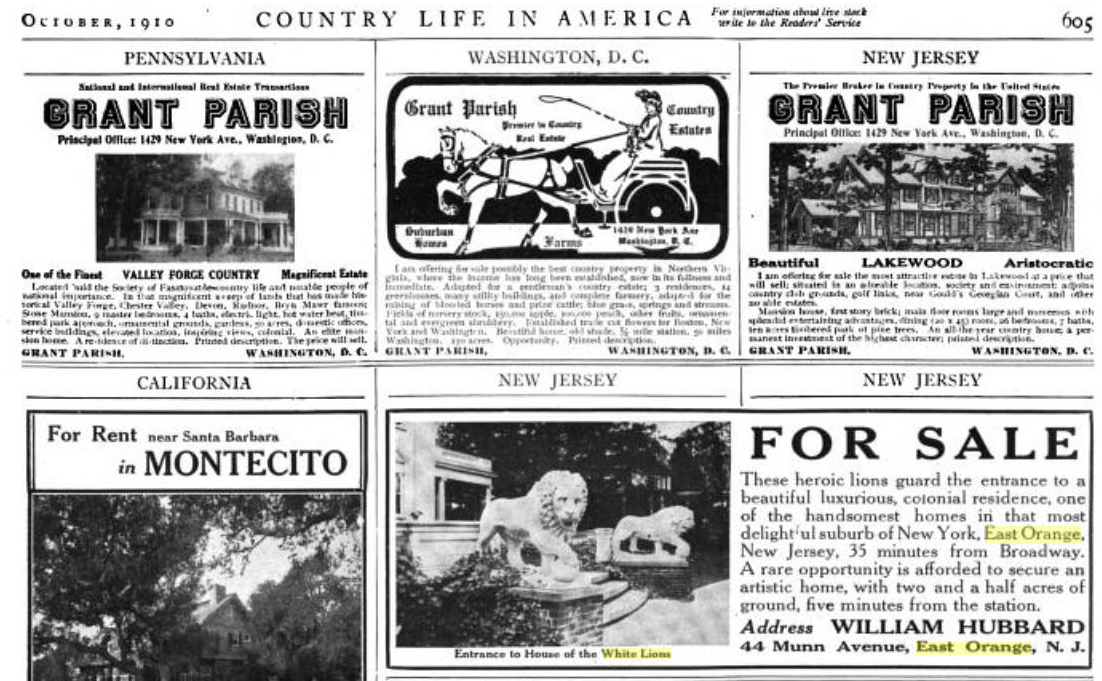
House of the White Lions


This house was at 44 South Munn Avenue, east side of Munn near the Chesnut Street intersection; It was the home of Winthrop Eugene Scarritt and was known as the "House of the White Lions." Mr. Scarritt was a staunch supporter of Teddy Roosevelt and his progressive agenda, and, when the progressive Republicans lost the House in 1910, Mr. Scarritt put his house up for sale and said he was leaving the country. Mr. Scarritt died in East Orange on December 7, 1911, so it appears that he did not sell his home or leave the country before his death.


"Mr. Scarritt  represented the City of New York in the National Good Roads convention at the Louisiana Purchase exposition in St. Louis (1904), delivering an address on "Good Roads, the Automobile and Civilization, " and was inspector of motor vehicles for the state of New Jersey in 1906. He was the author of "Three Men in a Motor Car" (1906) and of numerous magazine articles on the automobile and allied subjects. He was president of the Automobile Club of America in 1903-04; was a founder and vice-president of the American Automobile Association, and was a member of the Automobile Club of New Jersey, Aero Club of America, the leading automobile clubs and associations of Europe, and Phi Kappa Psi. During the later years of his life, he was also interested in aeronautics, making balloon flights both in this country and abroad. Scarritt was a 32d degree Mason. In religion he was a Methodist and politically was a Republican. He was married at Providence, RI, Sept 20, 1887, to Lerria, daughter of Horace Sumner Tarbell [whose biography is just before this one], and they had three sons: Winthrop Tarbell, Horace Sumner and Ellett Gibbs Scarritt. His death occurred at East Orange, NJ, Dec 7, 1911." (from American Biography, 1940)

The house later became the Elks Home and, in 1958, was torn down to be replaced by an apartment building.